
Shaping a Modern Approach to Vocational Education
Contempo College’s leadership is shaping a modern, outcomes-driven approach to vocational education by prioritising quality, compliance, and sustainable growth. Instead of rapid expansion, the College focuses on readiness, practical training, and integrated student support that strengthens employability. This disciplined, student-centred model positions Contempo as a reliable and trusted institution in an evolving VET sector.
INTERNATIONAL STUDENTS
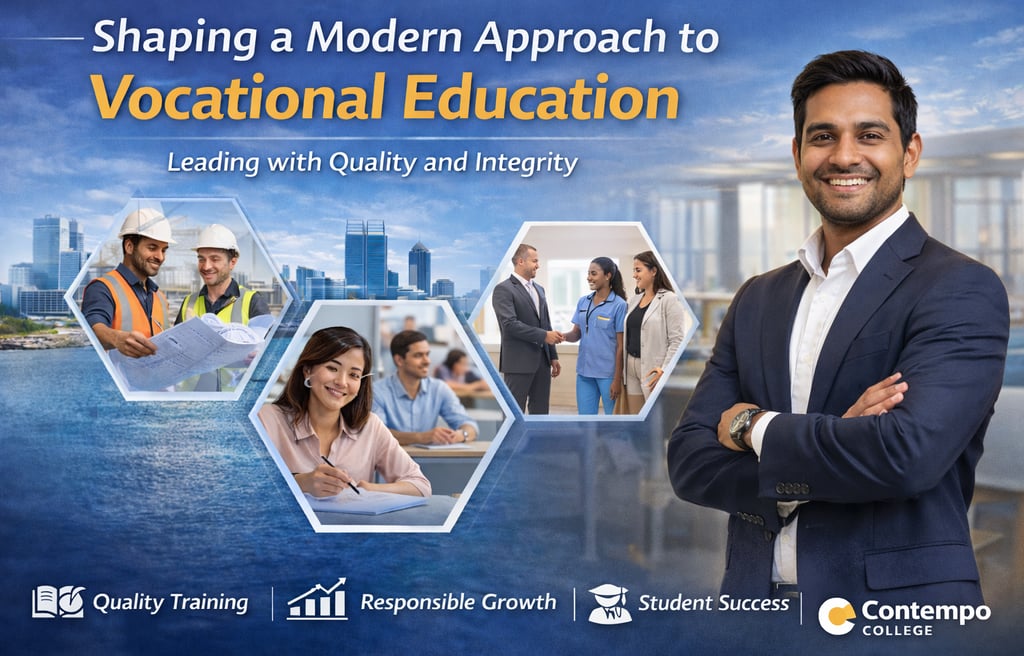
In Australia’s vocational education landscape, leadership is often judged by visibility. Announcements are frequent, ambitions expansive, language confident. What distinguishes Contempo College is not how loudly it speaks about transformation, but how quietly it executes it.
From an external perspective, the College’s leadership posture reflects a disciplined understanding of the VET sector’s realities. Regulatory scrutiny is high, student expectations are evolving, and industry tolerance for poorly prepared graduates is minimal. Against this backdrop, Contempo’s approach appears intentionally conservative in form and strategic in substance.
Rather than pursuing rapid scale, leadership decisions are framed around institutional readiness. Program growth is paced, aligned with internal capability, and tied to demonstrable workforce demand. This signals a governance philosophy that treats educational quality as non-negotiable and expansion as conditional. The emphasis is not on enrolling more students, but on preparing them properly.
Innovation within the College follows a similar logic. It is not presented as disruption, but as refinement. Delivery models evolve, practical exposure is strengthened, and student engagement mechanisms are updated, yet each adjustment is implemented within clear compliance boundaries. From a journalistic standpoint, this reflects a leadership team that understands innovation in vocational education must be defensible as well as effective.
What is particularly notable is how student outcomes are operationalised. Academic delivery, student support, and industry engagement do not appear to function as separate silos. Instead, they operate as an interconnected system. When students face difficulty, intervention is early and structured. When they succeed, the focus shifts quickly to employability and transition into the workforce. This integration suggests leadership that views education as a continuum rather than a transactional service.
For partners and stakeholders, the signal is clear. Contempo is positioning itself as a reliable institution in an often volatile sector. One where regulators encounter consistency, industry encounters graduates who meet expectations, and students encounter an environment designed to support completion with purpose.
In an era where trust has become the most valuable currency in education, Contempo’s leadership model offers a restrained but persuasive proposition. It is not built on spectacle or scale, but on governance, accountability, and a long-term commitment to outcomes that endure beyond the classroom.