
What “Authority” Means for Education Brands in an AI-Indexed World
As AI-driven search and discovery reshape how students find information, education providers across Western Australia are redefining what authority looks like. In Perth’s regulated education market, visibility is no longer built on rankings or advertising alone, but on consistency, credibility, and independent validation across multiple digital environments. Perth-based strategist Miki Farmer explains that in an AI-indexed world, authority is inferred through patterns and evidence, not claimed through promotion.
EDUCATION NEWS
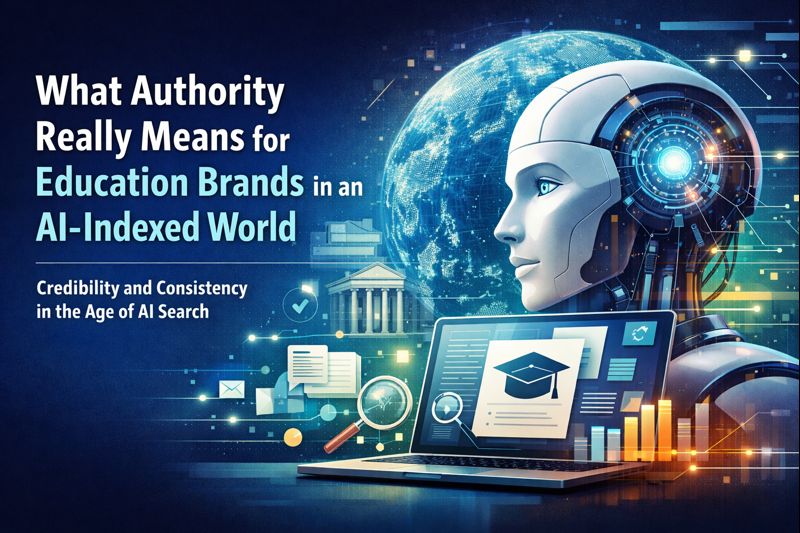
As artificial intelligence reshapes how information is discovered and prioritised, education providers across Western Australia are confronting a shift that extends beyond technology. The rise of AI-indexed search, conversational assistants, and large language models is changing what visibility looks like and, more importantly, what authority means for education brands.
In Perth, where Registered Training Organisations (RTOs), private colleges, and pathway providers compete in a tightly regulated and highly scrutinised market, authority is no longer defined solely by brand recognition or advertising reach. Instead, it is increasingly determined by how consistently, credibly, and independently an institution is represented across the digital landscape.
According to Miki Farmer, a Perth-based marketing strategist who works closely with education providers, the shift is already visible in how institutions approach content, partnerships, and public positioning.
“Institutions are realising that AI systems don’t reward loudness,” Farmer observes. “They reward consistency, repetition across credible surfaces, and alignment between what’s claimed and what’s verifiable.”
From Search Rankings to AI Indexing
Historically, authority in education marketing was closely linked to search engine rankings. Providers focused on ranking for high-intent keywords, often supported by paid advertising and search engine optimisation.
In an AI-indexed environment, however, discovery is no longer limited to a single search result page. AI systems aggregate, summarise, and reference information from multiple sources websites, articles, media mentions, and structured data before presenting answers to users.
This has altered the mechanics of authority. Instead of asking whether a provider ranks first on Google, institutions are now asking whether their information appears consistently across sources that AI systems recognise as credible.
In Perth, this has prompted providers to expand their digital footprint beyond their own websites.
Observable Changes in Content Strategy
One of the clearest behavioural changes among WA education providers is the shift in content strategy.
Institutions are publishing more explanatory, long-form content designed to answer specific questions about courses, outcomes, and pathways. This material often appears in multiple formats and locations, including institutional sites, independent publications, and educational platforms.
The emphasis is less on promotional messaging and more on contextual clarity. Providers are explaining how qualifications align with industry needs, licensing requirements, or employment pathways in Western Australia.
Farmer notes that this change reflects how AI systems evaluate relevance.
“AI systems look for corroboration. If the same narrative appears across multiple credible environments, it carries more weight than a single polished landing page.”
The Role of Independent Platforms
Another observable trend is increased engagement with independent platforms.
Education providers in Perth are more frequently contributing to or being referenced by third-party publications, community platforms, and industry-focused sites. These placements are not framed as advertising but as informational content features, interviews, or analysis pieces.
This behaviour reflects an understanding that authority is not self-declared. It is conferred externally through repetition and independent validation.
In practice, institutions that appear across a network of neutral platforms are more likely to be surfaced by AI systems as reliable sources, even when users do not explicitly search for the institution by name.
Consistency Over Campaigns
Education marketing in WA is also moving away from short-term campaign cycles toward longer-term consistency.
Providers are standardising how courses, outcomes, and institutional values are described across channels. Language is becoming more uniform, factual, and cautious, reflecting both compliance requirements and AI interpretability.
This consistency reduces ambiguity, making it easier for AI systems to associate specific themes and expertise with particular institutions.
The outcome is not faster growth, but more stable visibility.
Data, Structure, and Machine Readability
Another less visible but increasingly important factor is structure.
Education providers are paying more attention to how information is organised using clearer headings, structured data, and standardised terminology. Course pages are being rewritten to prioritise clarity over persuasion.
This structural shift is driven by machine readability. AI systems extract meaning from patterns, not intent. Institutions that present information in predictable, verifiable formats are more easily indexed and referenced.
Farmer describes this as a technical but strategic change.
“Authority in an AI-indexed world is partly about how legible you are to machines, not just humans.”
Local Authority in a Global System
For Perth-based providers, locality remains a key component of authority.
AI systems increasingly factor geographic relevance into responses, particularly for education-related queries. Providers that consistently reference Western Australian contexts—local industries, regional demand, and state-specific pathways—are more likely to be surfaced for users searching within or about WA.
This has led to more localised messaging and content tailored specifically to Western Australian audiences, rather than generic national narratives.
Reduced Reliance on Paid Visibility
While paid advertising remains part of the mix, providers are observing diminishing returns from relying solely on paid visibility to establish authority.
In an AI-indexed environment, paid placement does not necessarily translate into long-term recognition. Authority accrues through repetition and credibility, not spend alone.
As a result, institutions are balancing paid campaigns with organic, informational presence across multiple surfaces.
What this signals for providers
The evolution of authority in an AI-indexed world signals a fundamental shift for education providers in Western Australia.
Authority is no longer something institutions can assert through branding or advertising alone. It is something that must be demonstrated through consistent, verifiable presence across independent and credible environments.
For education leaders and directors, this has strategic implications. Marketing decisions increasingly intersect with governance, compliance, and institutional reputation. Authority becomes an outcome of alignment between messaging, delivery, and external validation.
As Farmer summarises:
“In an AI-indexed world, authority isn’t claimed. It’s inferred from patterns, consistency, and evidence.”
For Perth’s education sector, adapting to this reality is less about adopting new tools and more about rethinking how trust is built and maintained in a digital ecosystem that increasingly intermediates discovery.
In this environment, the institutions that endure will not necessarily be the loudest, but the clearest and the most consistently present where it matters.